Siding
Vinyl Siding vs. Fiber Cement Siding: Which Is Right for Your Upstate SC Home?
Two materials dominate the reside jobs we quote in Greenville: vinyl and fiber cement. Here's the honest head-to-head on cost, durability, and maintenance.
September 22, 2026 · 11 min read
Key Takeaways
• Vinyl siding costs less upfront, but fiber cement holds up better against Upstate SC's hail, humidity, and UV exposure.
• For Greenville SC homeowners comparing vinyl siding vs. fiber cement siding, fiber cement typically adds more resale value in higher-price neighborhoods.
• Vinyl requires almost no maintenance; fiber cement needs repainting every 10 to 15 years but resists rot, pests, and impact far better.
• HOA communities and historic districts in Greenville often require or strongly prefer the wood-look profile that fiber cement delivers.
• Both materials can be installed correctly or incorrectly. Caulk integrity and proper flashing matter more than the material itself in storm-prone areas.
Why Material Choice Matters More in Greenville's Climate
Two materials dominate the reside jobs we quote in Greenville: vinyl and fiber cement. They look similar in a brochure and radically different on a wall a decade later. If you're weighing vinyl siding vs. fiber cement siding for your Greenville SC home, the decision really comes down to three things: what you can spend, how long you plan to stay, and what your neighborhood expects. This is the head-to-head breakdown on cost, durability, and maintenance so you can make the right call before you sign anything.
Not sure which siding material fits your home and budget? We can walk you through it, contact us for a free estimate or call (864) 505-4491.
Humidity, pollen, afternoon thunderstorms rolling off the Blue Ridge, and the occasional January ice storm. Upstate SC puts exterior siding through a real stress test every single year. Summer highs push into the 90s. Winter lows drop into the 20s. Average humidity runs 70 to 75 percent. That kind of range punishes the wrong material fast.
This article gives you a straight comparison of vinyl siding and fiber cement siding across cost, durability, maintenance, and long-term fit. We install both materials every week across Spartanburg, Greer, Simpsonville, Taylors, and the surrounding Upstate. You can browse our siding services page to see the full scope of what we do. But first, let us help you figure out which material actually makes sense for your home.
This is a practical comparison. Not a sales pitch for one product over the other. The right answer depends on your budget, your neighborhood, and how much upkeep you want to deal with down the road.
What's the Actual Difference Between Vinyl and Fiber Cement Siding?
These two materials look similar in photos. In person, on a job site, they are completely different animals. Here's what you're actually buying.
What Vinyl Siding Is Made Of
Vinyl siding is extruded PVC plastic, formed into interlocking panels. It's lightweight, comes in dozens of colors, and costs less upfront than almost anything else on the market.
Standard vinyl is a hollow panel. Insulated vinyl adds a foam backer bonded to the rear of the panel, pushing the R-value to roughly R-2 to R-4 depending on foam thickness. In Simpsonville or Mauldin, where summer heat gain through exterior walls runs up your cooling bill, that upgrade is worth a real conversation. It won't replace wall insulation, but it's a meaningful improvement over bare PVC.
What Fiber Cement Is Made Of
Fiber cement is a compressed blend of Portland cement, sand, and cellulose fiber. James Hardie is the dominant brand for siding in the Upstate SC market, and for good reason. Their ColorPlus factory-painted panels come pre-primed and pre-painted, which cuts long-term repainting costs significantly.
LP SmartSide is an engineered wood alternative worth mentioning. It's not fiber cement, but it performs well in humid climates, installs a bit lighter, typically runs $8 to $13 installed, and carries a manufacturer warranty that some homeowners find appealing when they want the workability of wood without the rot risk.
Fiber cement runs about 2.5 times heavier per square foot than vinyl. That weight matters. Improper fastening voids the James Hardie manufacturer warranty outright. The crew's experience level matters more here than with lighter materials.
How They Look Side by Side
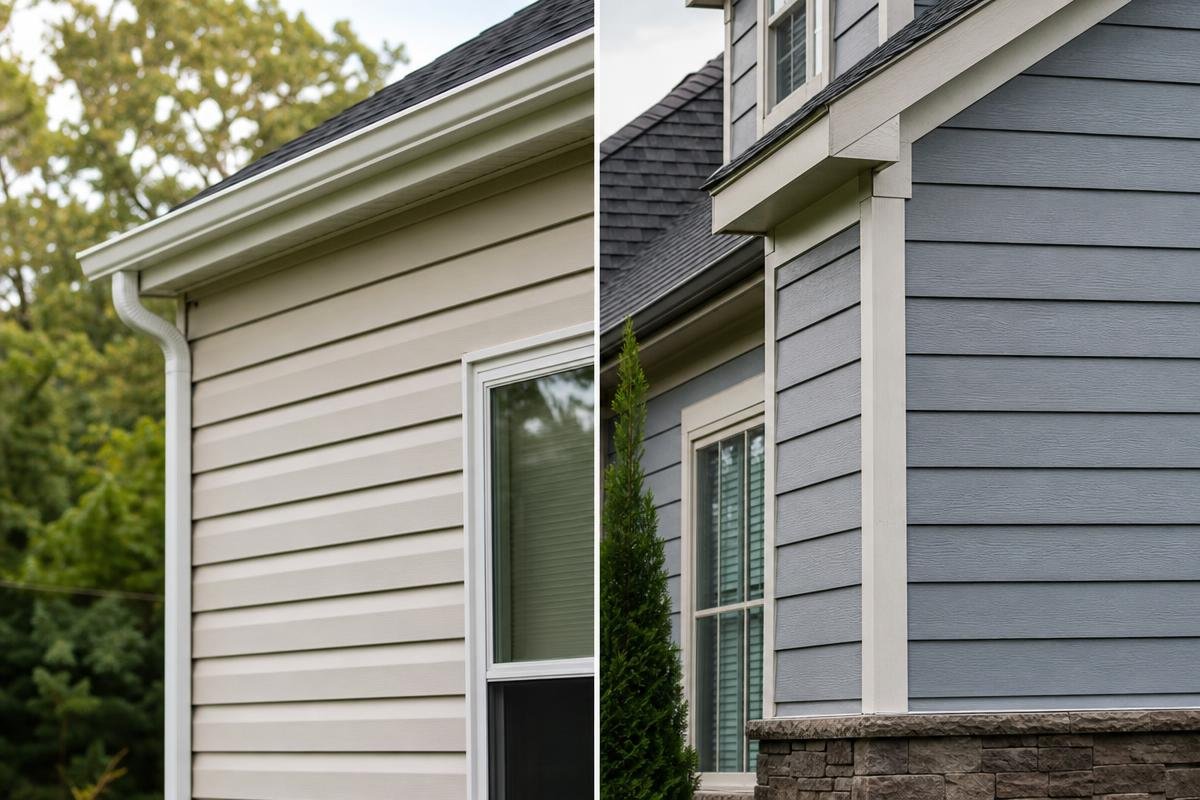
Vinyl mimics wood grain. Up close, it reads as plastic. Fiber cement holds paint and texture differently. From the street, it is nearly indistinguishable from real wood.
In neighborhoods like Travelers Rest or along the Pelham Road corridor where HOAs have aesthetic standards, fiber cement clears the bar that vinyl sometimes doesn't. You can see completed siding projects on both materials in our gallery and judge for yourself.
If curb appeal matters to your resale plan, fiber cement wins on looks, full stop.
What Does Siding Cost in Greenville, SC? Vinyl vs. Fiber Cement Pricing
National cost estimator tools will give you a number. That number is probably wrong for the Upstate. Labor rates here run below the national average, but material prices have normalized since the supply chain mess of recent years. What you pay in Simpsonville or Mauldin on a single-story ranch is going to look different from a two-story older home up in North Main. Story count, trim complexity, and tear-off all move the needle fast.
Vinyl Siding Cost Per Square Foot Installed
Standard vinyl costs roughly $4 to $8 per square foot installed in Greenville, SC in 2026. That range covers basic lap profiles up through thicker premium panels. Step up to insulated vinyl with a foam backer and you're looking at $6 to $10 for a finished install. The foam backer adds a real R-value boost, which matters when summer temps push into the 90s and your AC is already working hard.
Fiber Cement Siding Cost Per Square Foot Installed
James Hardie fiber cement costs about $10 to $16 per square foot installed in this market. The higher cost is real, and it's earned. Fiber cement is heavier, takes more labor hours, requires specialized fastening, and needs paint unless you go with ColorPlus factory-finished panels. ColorPlus adds roughly $1 to $2 to the finished square-foot price upfront, but it cuts your long-term repainting costs over the product's life. For homeowners in Five Forks or the foothills ZIPs where home values have climbed, that tradeoff makes sense.
Higher-value corridors like Augusta Road, where older homes with wood siding are being reclad to match neighborhood character, also tend toward fiber cement for HOA compatibility and the authentic wood-look profile. Fiber cement holds up better against the hail events that hit Greenville and Spartanburg counties most springs.
Total Project Cost: What a Full Reside Actually Runs
On a typical 1,500 to 2,000 square foot home, a full vinyl reside runs $6,000 to $16,000. Fiber cement on the same home runs $15,000 to $32,000, depending on story count and trim work. Before you start any siding replacement project, get a real on-site estimate, not a guess from a website.
The cheapest bid is rarely the best value, especially when the wrong installation voids your warranty.
Want real numbers for your actual home? Get a free siding estimate for your Greenville property, measured on site, not guessed from a spreadsheet.
Which Lasts Longer? Lifespan and Durability in Upstate SC Conditions
The Upstate is not gentle on exterior siding. Summer highs push into the 90s. January lows drop into the 20s. Average humidity runs 70 to 75 percent year-round. That temperature swing alone puts real stress on whatever is covering your walls.
Vinyl Siding Lifespan in South Carolina's Climate
Quality vinyl carries a 20 to 40 year manufacturer warranty. But that range matters. Cheap, thin-gauge panels at 0.040 inches or less can fade, warp, and go brittle in 10 to 15 years here. Ask for panels at 0.044 inches or thicker. That extra material holds up against UV exposure and the expansion and contraction this climate demands.
Vinyl expands and contracts significantly across our temperature range. When it is installed too tight, panels buckle. When it is installed too loose, gaps open up. Either way, water gets in. Proper installation matters as much as the panel itself.
Fiber Cement Lifespan and Storm Performance
James Hardie siding, the brand Upstate SC homeowners choose most often, carries a 30-year non-prorated warranty. Fiber cement does not warp, rot, or go brittle with UV exposure. It is Class 1A fire-rated. And it does not dent from hail the way vinyl panels do.
That last point is real money in Greenville County. Spring hail events here regularly put dents in vinyl panels that require full board replacement. Fiber cement shrugs off the same storm. For homeowners in Simpsonville, Taylors, or Greer, that difference shows up on your insurance history and your repair bill.
How Upstate SC Weather Tests Both Materials
The Blue Ridge escarpment just north of here drives the wind-driven rain that soaks the north and west walls of many Upstate homes. Caulk integrity and proper flashing matter more in this market than in flatter parts of South Carolina. Fiber cement is dimensionally stable across our full temperature range. Vinyl is not.
If you want a deeper read on how both materials hold up across the state, our guide to the best siding for South Carolina homes covers the full picture. Bottom line here: fiber cement wins on raw durability. Vinyl can still perform well, but only with the right panel thickness and a crew that installs it correctly.
Maintenance: How Much Work Are You Signing Up For?
The humidity that lingers after summer storms is no joke. Simpsonville, Mauldin, Taylors, every home out here deals with 70 to 75 percent average summer humidity and UV from south-facing walls. Your siding takes that beating every single year. What you pick now determines how much work you do later.
Vinyl Siding Maintenance Requirements
Vinyl is about as close to no-maintenance as exterior siding gets. Rinse it once a year with a garden hose or pressure washer. If mold or mildew shows up on a shaded wall, a bleach-and-water mix handles it. That's most of your annual to-do list.
You will never paint vinyl siding. The color is baked into the material at the factory. If a panel cracks after a hail event, you replace that panel, not the whole wall. Caulk around windows and trim every 5 to 7 years and you're in good shape.
Fiber Cement Maintenance Requirements
Fiber cement takes more attention. Plan on repainting every 7 to 15 years depending on sun exposure and paint quality. South-facing walls in the Upstate get more UV than you'd expect, and that accelerates fade. James Hardie's factory ColorPlus finish pushes that cycle out, but it's still a real cost to plan for.
Caulk maintenance matters even more with fiber cement. Cut edges will absorb moisture if caulk fails, and that causes swelling. Check caulk lines every year. The good news: when you do repaint, fiber cement holds paint beautifully and you can change the color completely.
The Real Long-Term Cost of Each
Over 30 years, fiber cement's periodic repainting can add $3,000 to $6,000 to your total cost. Vinyl's maintenance is close to zero beyond a hose and some caulk. Budget-conscious homeowners in Boiling Springs or Lyman often find vinyl wins on total cost. Homeowners in higher-value areas where resale ROI matters more sometimes land on fiber cement because the material will likely outlast the vinyl.
Neither material is wrong. It depends on what you value more: lower bills now or fewer replacements later. For more on picking the right product for your home, see our full siding services page or read our guide to the best siding for South Carolina homes.
Not sure which material fits your budget and your block? Call us at (864) 505-4491 and we'll walk you through it straight.
Which Siding Is Right for Your Greenville Home? A Practical Decision Guide
There's no universal right answer here. The best choice depends on your neighborhood, your timeline, and your budget. Here's how to cut through the noise.
Choose Vinyl If...
• Budget is your primary driver and you need the lowest installed cost
• The home is a rental, a flip, or a short-term hold
• You want a true zero-maintenance exterior
• You're in Mauldin, Greer, or Simpsonville and the comps won't support fiber cement's price premium at resale
• You need a faster installation turnaround
One upgrade worth considering: insulated vinyl. It adds R-value to your wall assembly and handles Upstate heat better than standard vinyl. For a home you're keeping 5 to 10 years, it's the smart middle ground.
Choose Fiber Cement If...
• You're staying 15 or more years
• You're on the Augusta Road corridor, in the North Main Historic District, or in the foothills around Travelers Rest (ZIP codes 29690 and 29681), where home values have climbed and curb appeal drives resale
• Your HOA requires a wood-look material
• You've replaced vinyl panels after hail seasons and you're tired of doing it again
• Fire resistance matters to you
James Hardie is the go-to brand in this category, the best siding for South Carolina homes in higher-value markets. The warranty is real. The product holds up. In higher-value markets, the ROI is there.
What About Board-and-Batten and Shake Profiles?
Both materials come in board-and-batten and shake, not just lap siding. James Hardie HardiePanel board-and-batten is extremely popular on Craftsman and farmhouse-style homes in Upstate SC's older neighborhoods. Vinyl shake works well as a lower-cost gable accent.
Same crew installs both profiles. If you want to see how these look finished, check out our siding options for Greenville homes on the Greenville location page and browse completed projects before you decide.
Why Greenville Homeowners Trust American Siding & Construction
We install both vinyl siding and fiber cement siding across the Upstate, from Simpsonville and Mauldin to Greer, Taylors, and everywhere in between. One call covers it all. The crew that starts your project is the crew that finishes it, every day, start to finish.
That crew is led by founder Billy Tello. Our customers say Billy responds fast, communicates clearly, and holds his team to a high standard of detail. One reviewer noted he came out quickly to fix a hanging vinyl panel after a storm. Others mention how easy he is to reach and how the project went exactly as explained. Those aren't accidents. That's how Billy runs things.
American Siding & Construction carries 142 five-star Google reviews with a 5.0 average rating. Homeowners across Spartanburg, Duncan, Boiling Springs, and the broader Upstate SC market keep coming back to the same theme: reliable crew, clean work, no surprises. You can see completed siding projects from neighborhoods just like yours in our project gallery.
We work with James Hardie fiber cement and quality vinyl products. We know which material fits which home, which neighborhood, and which budget. Whether you are leaning toward fiber cement siding or vinyl siding, our team will give you a straight answer, not a sales pitch. Give us a call. Chances are we have done it.
Frequently Asked Questions
Which siding handles Greenville's heat and humidity better?
Both materials hold up in our climate. Fiber cement is dimensionally stable, meaning it does not expand and contract with temperature swings the way vinyl does. If you have south-facing walls that take full afternoon sun, thin-gauge vinyl can warp over time. Insulated vinyl is the better vinyl option for heat resistance on those exposures.
What does a full siding replacement cost in Greenville, SC?
Vinyl typically runs $6,000 to $16,000 installed. Fiber cement runs $15,000 to $32,000 on a typical Upstate home. Square footage, story count, and trim complexity all move the number. We give you a firm price before any work starts, no surprises on invoice day.
Does fiber cement siding add resale value in Greenville?
Yes, especially in mid-to-upper price-point neighborhoods. Realtors working the Augusta Road corridor and North Main Historic District consistently flag James Hardie siding as a selling point. Vinyl still adds value over deteriorated original siding, but fiber cement carries more weight at resale in those markets.
Can I install fiber cement siding myself?
We strongly advise against it. James Hardie siding installations in Upstate SC require professional installation to keep the warranty valid. Panels weigh up to 4 lbs per square foot and need fiber cement shears or a PCD blade circular saw. Improper fastening depth voids the warranty outright.
How long does a siding replacement take in Greenville?
Vinyl runs 3 to 7 days on a 1,500 to 2,000 sq ft reside. Fiber cement runs 5 to 10 days. Spring and fall are the best windows here. Summer heat slows caulk and paint curing on fiber cement, which adds time.
Do you install both vinyl and fiber cement siding in Greenville and surrounding areas?
Yes. American Siding & Construction installs both materials across Simpsonville, Mauldin, Greer, Spartanburg, and the rest of Upstate SC. Reach out through our contact page or call us at (864) 505-4491. One call does it all.
Ready to Get Started with American Siding & Construction LLC?
Call (864) 505-4491 to speak with our team directly. We're ready to answer your questions, walk you through your options, and help you find the right solution for your needs. Whether you're just starting to plan or ready to move forward, we'll make the process simple and stress-free.
See what fiber cement and vinyl look like on real Upstate homes, then let's talk about your project, view our project gallery or call us.
Thinking about a project like this?
Get a free estimate